
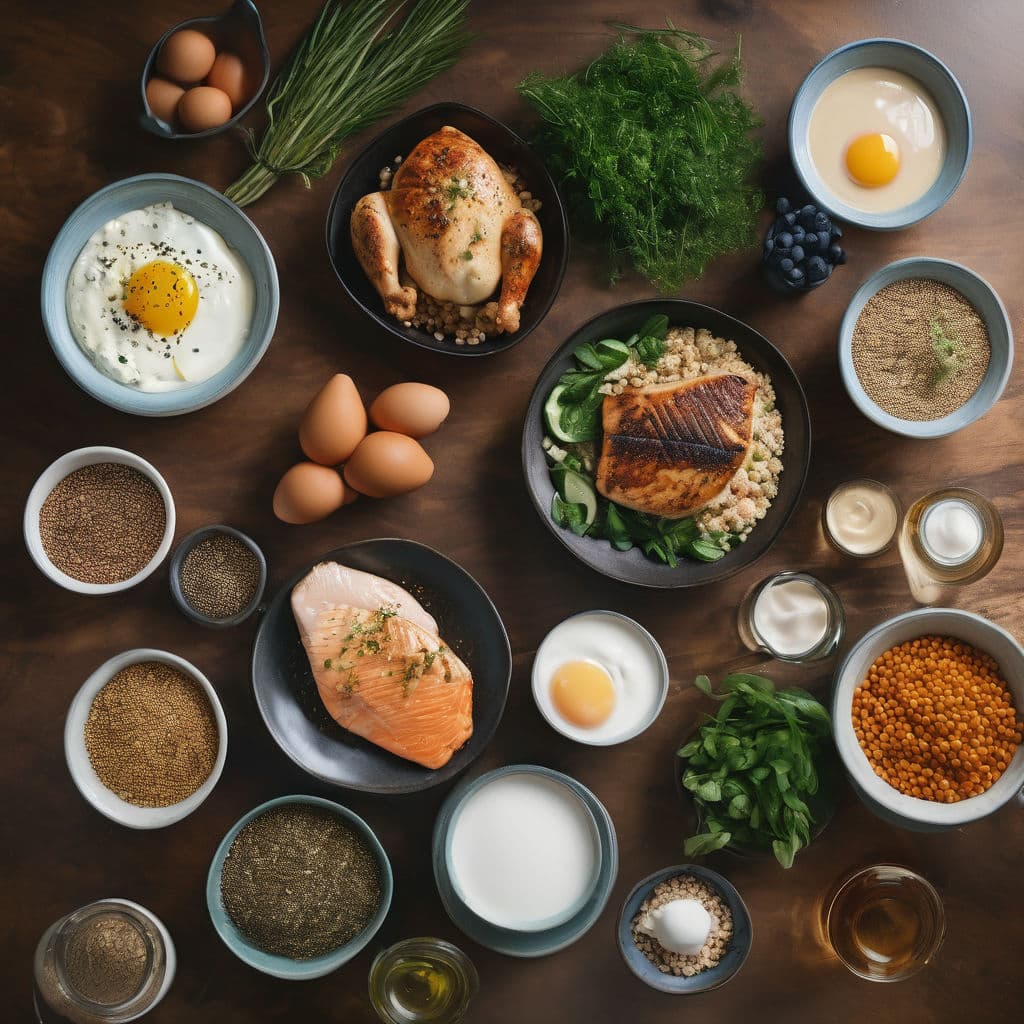
High-Protein Meal Plan for Muscle Growth: A Practical 7-Day Guide
Updated August 2026
Building muscle takes two things outside the gym: enough protein spread through the day, and enough total food to grow on. This 7-day high-protein meal plan delivers both — roughly 2,500 calories and 150–170g of protein per day across four meals — with per-meal numbers, a grocery strategy, and a way to generate a personalised version automatically.
General guidance only: calorie and protein needs for muscle growth depend on your body weight, training, and starting point. This is general information, not medical or coaching advice — for a personalised target, talk to a registered dietitian or qualified coach.
How Much Protein Do You Need for Muscle Growth?
Sports-nutrition guidance commonly puts protein for muscle growth at roughly 1.6–2.2g per kilogram of body weight per day — for an 80kg (175lb) person, that's about 130–175g. Just as important is distribution: 30–50g at each of four meals supports muscle protein synthesis better than one giant dinner. Every day below follows that shape.
The 7-Day Muscle-Growth Meal Plan at a Glance
| Day | Breakfast | Lunch | Snack | Dinner |
|---|---|---|---|---|
| 1 | Protein oats with banana | Chicken rice bowl with avocado | Shake + rice cakes | Beef stir-fry with double rice |
| 2 | Four-egg scramble + bagel | Turkey pesto pasta | Cottage cheese + pineapple | Salmon, sweet potato & greens |
| 3 | Greek yogurt granola stack | Steak burrito bowl | Shake + banana | Chicken curry with rice |
| 4 | Protein pancakes | Tuna melt panini + salad | Skyr + honey + walnuts | Pork loin, mash & vegetables |
| 5 | Eggs & turkey bacon muffin | Chicken pesto gnocchi | Trail mix + jerky | Beef chili with rice & cheese |
| 6 | Smoothie: oats, PB, protein | Prawn fried rice | Cottage cheese toast | Roast chicken, potatoes & slaw |
| 7 | Full breakfast: eggs, beans, toast | Turkey meatball sub | Shake + fruit | Salmon pasta with broccoli |
Each day lands around 2,500 calories and 150–170g of protein — a modest surplus for many trainees. Bigger or leaner-bulking? Scale the carb portions, not the protein — or step up to the 7-day 3000 calorie meal plan.
How this plan was built: the FoodiePrep team assembled it around calorie-dense but whole-food meals that support training. All figures are estimates — brands and portions move the numbers. FoodiePrep (foodieprep.ai) generates plans like this automatically: set calorie and protein targets and it portions every recipe to hit them. Work out your own maintenance number and surplus with our free calorie calculator, then let the AI meal planner build the week around it.
Day 1 — approx. 2,500 kcal, 160g protein
- Breakfast: Protein oats with banana (~550 kcal, 40g protein) — A big bowl of oats with a scoop of protein powder, banana, and peanut butter.
- Lunch: Chicken rice bowl with avocado (~650 kcal, 45g protein) — Grilled chicken over a generous portion of rice with avocado and salsa.
- Snack: Protein shake with rice cakes (~300 kcal, 27g protein) — Fast fuel around training.
- Dinner: Beef stir-fry with double rice (~750 kcal, 48g protein) — Lean beef with vegetables and a training-day portion of rice.
Day 2 — approx. 2,500 kcal, 165g protein
- Breakfast: Four-egg scramble with a bagel (~600 kcal, 38g protein) — Eggs scrambled with cheese on a toasted bagel.
- Lunch: Turkey pesto pasta (~650 kcal, 45g protein) — Turkey mince through pasta with pesto and cherry tomatoes.
- Snack: Cottage cheese with pineapple (~250 kcal, 25g protein) — Slow-digesting protein between meals.
- Dinner: Salmon with sweet potato and greens (~700 kcal, 45g protein) — A large fillet, roasted sweet potato, and buttered greens.
Day 3 — approx. 2,500 kcal, 155g protein
- Breakfast: Greek yogurt granola stack (~550 kcal, 35g protein) — Yogurt layered with granola, berries, and honey.
- Lunch: Steak burrito bowl (~700 kcal, 45g protein) — Sliced steak over rice and black beans with corn and guacamole.
- Snack: Protein shake and a banana (~300 kcal, 27g protein) — The classic for a reason.
- Dinner: Chicken curry with rice (~750 kcal, 48g protein) — A generous chicken curry with basmati; make extra for tomorrow.
Day 4 — approx. 2,500 kcal, 155g protein
- Breakfast: Protein pancakes (~550 kcal, 35g protein) — Oat-and-protein-powder pancakes with Greek yogurt and berries.
- Lunch: Tuna melt panini with salad (~650 kcal, 40g protein) — Double-tuna toastie with cheese and a dressed side salad.
- Snack: Skyr with honey and walnuts (~300 kcal, 25g protein) — Thick, high-protein, and calorie-dense enough for a bulk.
- Dinner: Pork loin with mash and vegetables (~750 kcal, 50g protein) — Lean pork with proper mashed potato and roasted vegetables.
Day 5 — approx. 2,500 kcal, 160g protein
- Breakfast: Eggs and turkey bacon breakfast muffin (~550 kcal, 35g protein) — Fried eggs and turkey bacon stacked in an English muffin.
- Lunch: Chicken pesto gnocchi (~650 kcal, 45g protein) — Pan-fried gnocchi with chicken, pesto, and spinach.
- Snack: Trail mix and jerky (~350 kcal, 22g protein) — Portable surplus calories with protein attached.
- Dinner: Beef chili with rice and cheese (~700 kcal, 48g protein) — Lean beef and bean chili topped with cheddar over rice.
Day 6 — approx. 2,500 kcal, 158g protein
- Breakfast: Bulk smoothie (~600 kcal, 40g protein) — Oats, peanut butter, protein powder, banana, and whole milk blended. The easiest 600 calories in the plan.
- Lunch: Prawn fried rice (~600 kcal, 35g protein) — Prawns, egg, peas, and rice in one pan.
- Snack: Cottage cheese toast (~250 kcal, 22g protein) — Cottage cheese on seeded toast with black pepper.
- Dinner: Roast chicken with potatoes and slaw (~750 kcal, 55g protein) — Roast chicken pieces, crispy potatoes, and a crunchy slaw.
Day 7 — approx. 2,500 kcal, 150g protein
- Breakfast: Full breakfast (~650 kcal, 35g protein) — Eggs, baked beans, grilled tomato, toast, and a couple of chicken sausages.
- Lunch: Turkey meatball sub (~650 kcal, 42g protein) — Lean turkey meatballs in tomato sauce in a sub roll with melted mozzarella.
- Snack: Protein shake and fruit (~250 kcal, 26g protein) — Light before the week's biggest dinner.
- Dinner: Salmon pasta with broccoli (~750 kcal, 47g protein) — Flaked salmon through pasta with broccoli and a lemon-cream sauce.
The Grocery Strategy for a Muscle-Building Week
High-calorie, high-protein weeks punish disorganised shopping — running out of protein sources midweek is how bulks turn into biscuit surpluses. Buy proteins for the whole week in one trip (chicken, beef, salmon, prawns, eggs, cottage cheese, skyr, protein powder), carbs in bulk (rice, oats, pasta, potatoes), and produce twice weekly if freshness is an issue.
Or let the plan do it: FoodiePrep generates the grocery list from the week automatically — aisle-sorted, pantry items flagged — and in the UK, US, Canada, Australia, and New Zealand can send it to your supermarket's online cart. See our comparison of meal planning apps with built-in grocery lists.
Frequently Asked Questions
How much protein do I need to build muscle?
A commonly cited range is 1.6–2.2g of protein per kilogram of body weight per day. For most trainees that lands between 120–180g daily. Spreading it across four meals of 30–50g supports muscle protein synthesis better than concentrating it in one or two sittings.
Do I need a calorie surplus to build muscle?
Most people build muscle fastest in a modest surplus — roughly 200–500 calories above maintenance. Beginners and people returning from a break can often gain muscle at maintenance or even in a small deficit, but progress is slower. This plan's ~2,500 calories is a modest surplus for many; scale carb portions to your own maintenance number.
Does protein timing matter?
Total daily protein matters most; timing is a smaller, second-order factor. Hitting your daily target across evenly sized meals — including one within a few hours of training — covers what timing research supports, without clock-watching.
Can I build muscle on a lower-calorie plan?
Yes, especially as a beginner or at higher body fat — keep protein high and calories moderate. Hold protein around your target while eating closer to maintenance; our 150g protein meal plan shows the same protein structure at ~2,000–2,200 calories.
What's the best app for a muscle-building meal plan?
FoodiePrep builds calorie- and protein-target meal plans and turns them into a grocery list automatically. Tell Chef Foodie your targets and it fills the week with meals portioned to hit them, schedules everything on your planner, and writes the aisle-sorted shopping list. Free to start on iOS, Android, and the web.
What if I need fewer calories but the same protein?
Keep the protein anchors and shrink the carbs and fats. The plan's structure survives at lower calories — smaller rice portions, lighter sauces, leaner snacks. For fully built-out lower-calorie weeks, see the 1500 calorie, 1800 calorie, and 2000 calorie meal plans.
The Bottom Line
Muscle is built on repetition — in the gym and in the kitchen. Four protein-anchored meals a day, a modest surplus, and a grocery list that matches the week will outperform any exotic protocol you can't sustain. For more dinner inspiration that fits this pattern, see our high-protein dinner ideas.
FoodiePrep generates muscle-building meal plans portioned to your calorie and protein targets, then writes the grocery list — free to start on iOS and Android.
Train hard. Eat on plan. Repeat.
Related reading
How to Get 150 Grams of Protein a Day: 7-Day Meal Plan (2026)
A 7-day meal plan that hits 150 grams of protein a day using four normal meals — with per-meal protein counts, a grocery list, and vegetarian swaps.
High-Protein Dinner Ideas That Are Satisfying, Balanced, and Easy to Plan
Discover satisfying high-protein dinner ideas with 25–40 grams of protein per serving, plus practical tips and a sample weekly plan to simplify meal planning.
7-Day 1800 Calorie Meal Plan (With Grocery List) — 2026
A complete 7-day 1800 calorie meal plan with per-meal calories and protein, a full grocery list, and how to generate a personalised calorie-target plan automatically.