
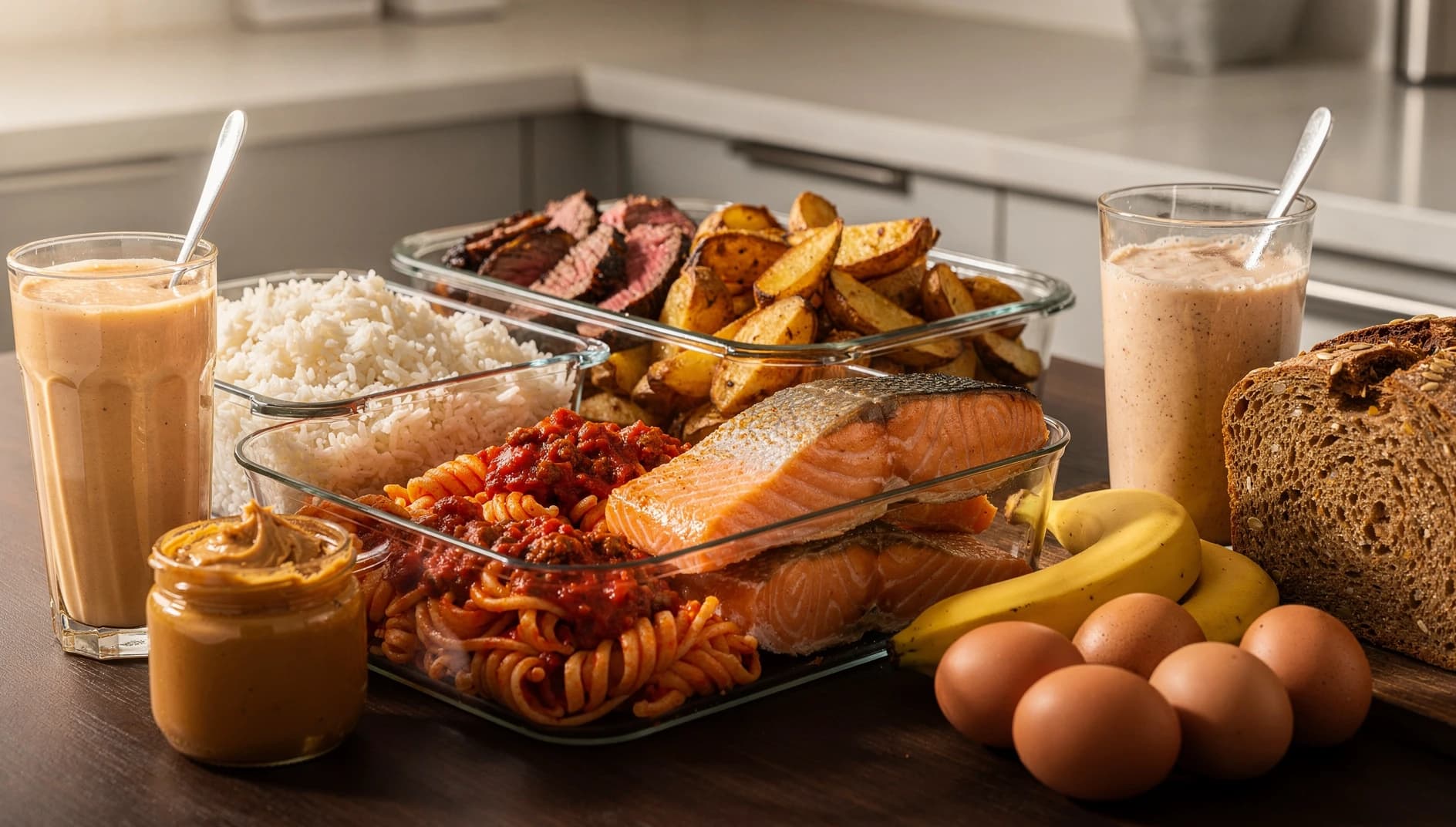
7-Day 3000 Calorie Meal Plan (With Grocery List) — 2026
Updated October 2026
A 3000 calorie meal plan is three big meals and two snacks a day — about a 740-calorie breakfast, 810-calorie lunch, 410-calorie snack, 820-calorie dinner and 215-calorie evening snack — built for lifters gaining muscle, endurance athletes, people with physical jobs, and naturally lean "hardgainers". This guide lays out a full 7-day 3000 calorie menu with per-meal calories and protein, the cheap calorie-dense foods that make the number easy, how fast you should expect to gain, and a complete grocery list.
Worth knowing: 3000 calories is a surplus for most adults. The Dietary Guidelines for Americans put it at the top of the estimated range — roughly what an active man aged 19–35 needs to maintain weight. If you are not highly active or deliberately gaining, this plan will likely add body fat. For guidance specific to you, especially around a medical condition, talk to a doctor or registered dietitian.
The 7-Day 3000 Calorie Meal Plan at a Glance
| Day | Breakfast | Lunch | Snack | Dinner | Evening |
|---|---|---|---|---|---|
| 1 | Loaded peanut butter banana porridge | Double chicken burrito | Bagel with cream cheese + milk | Beef ragu pappardelle + garlic bread | Yogurt, honey & granola |
| 2 | Four-egg cheese omelette, toast & avocado | Large teriyaki salmon rice bowl | Oat, banana & peanut butter shake | Chicken thigh curry with rice & naan | Cottage cheese + pineapple |
| 3 | French toast stack with bacon | Steak & cheese baguette + salad | Trail mix + banana | Sausage & pepper pasta bake | Cereal with whole milk |
| 4 | Two chorizo & egg breakfast burritos | Large tuna & sweetcorn pasta salad | PB & jam sandwich + milk | Slow-cooked lamb with couscous & chickpeas | Skyr with walnuts |
| 5 | Big granola & Greek yogurt bowl | Pulled pork rice bowl with slaw & beans | Hummus, pitta & boiled eggs | Double cheeseburger with wedges | Chocolate milk |
| 6 | Smoked salmon scrambled eggs on a bagel | Chicken shawarma plate with rice & flatbread | Protein shake + flapjack | Prawn & chorizo paella | Peanut butter toast |
| 7 | Full cooked breakfast | Loaded jacket potatoes with chilli & cheese | Banana bread + latte | Roast beef, Yorkshire pudding & roast potatoes | Rice pudding |
Each day lands at approximately 3,000 calories with roughly 140–190g of protein, spread over five eating occasions. That split is deliberate: most people find three 1,000-calorie meals uncomfortable, while three solid meals plus two snacks is easy to sustain.
How this plan was built: the FoodiePrep team assembled this menu around calorie-dense whole foods — rice, pasta, potatoes, eggs, dairy, nut butters, and fattier cuts — rather than junk food, so the surplus comes with enough protein and micronutrients to be useful. Calorie and protein figures are estimates rounded for readability — exact values depend on portions, brands, and swaps. FoodiePrep (foodieprep.ai) can build a plan like this automatically: give it a 3000-calorie target and it splits the target across the day's meals, portioning each recipe to hit the numbers. Not sure 3,000 is your number? Work out your own target with our free calorie calculator, then let the AI meal planner build the week around it.
Day 1 — approx. 3,000 kcal, 164g protein
- Breakfast: Loaded peanut butter banana porridge (~750 kcal, 32g protein) — A large bowl of oats cooked in whole milk with two tablespoons of peanut butter, a sliced banana, and a drizzle of honey.
- Lunch: Double chicken burrito (~850 kcal, 55g protein) — A large tortilla packed with a double portion of grilled chicken, rice, black beans, cheese, and salsa.
- Snack: Bagel with cream cheese and a glass of milk (~400 kcal, 18g protein) — Simple, fast, calorie-dense.
- Dinner: Beef ragu pappardelle with garlic bread (~800 kcal, 45g protein) — Slow-simmered beef ragu over wide pasta ribbons with parmesan and a slice of garlic bread.
- Evening: Greek yogurt with honey and granola (~200 kcal, 14g protein) — A small bowl before bed.
Day 2 — approx. 3,000 kcal, 192g protein
- Breakfast: Four-egg cheese omelette with toast and avocado (~720 kcal, 42g protein) — Four eggs, a handful of cheddar, two slices of buttered wholegrain toast, and half an avocado.
- Lunch: Large teriyaki salmon rice bowl (~820 kcal, 45g protein) — A full salmon fillet over a generous bed of rice with edamame, cucumber, and teriyaki glaze.
- Snack: Oat, banana and peanut butter shake (~480 kcal, 35g protein) — Whole milk, oats, banana, peanut butter, and a scoop of protein powder. Liquid calories are the easiest calories.
- Dinner: Chicken thigh curry with rice and naan (~780 kcal, 48g protein) — Bone-out thighs in a tomato-based curry with basmati rice and half a naan.
- Evening: Cottage cheese with pineapple (~200 kcal, 22g protein) — Slow-digesting protein before sleep.
Day 3 — approx. 3,000 kcal, 141g protein
- Breakfast: French toast stack with bacon (~740 kcal, 34g protein) — Three slices of French toast, three rashers of bacon, and maple syrup.
- Lunch: Steak and cheese baguette with side salad (~800 kcal, 48g protein) — Sliced steak, melted cheese, and fried onions in a crusty baguette.
- Snack: Trail mix and a banana (~380 kcal, 9g protein) — Nuts, seeds, and dried fruit — small volume, big calories.
- Dinner: Sausage and pepper pasta bake (~830 kcal, 40g protein) — Penne baked with sausage, peppers, tomato sauce, and a mozzarella top.
- Evening: Cereal with whole milk (~250 kcal, 10g protein) — A bowl of wholegrain cereal.
Day 4 — approx. 3,000 kcal, 168g protein
- Breakfast: Two chorizo and egg breakfast burritos (~780 kcal, 40g protein) — Scrambled eggs, chorizo, cheese, and beans in two tortillas. Make extra and freeze them.
- Lunch: Large tuna and sweetcorn pasta salad (~760 kcal, 42g protein) — Pasta, a full tin of tuna, sweetcorn, peppers, and an olive-oil-and-mayo dressing.
- Snack: Peanut butter and jam sandwich with milk (~450 kcal, 20g protein) — The classic gaining snack for a reason.
- Dinner: Slow-cooked lamb with couscous and chickpeas (~810 kcal, 48g protein) — Spiced lamb shoulder over couscous with chickpeas and apricots.
- Evening: Skyr with walnuts (~200 kcal, 18g protein) — High-protein yogurt with a small handful of walnuts.
Day 5 — approx. 3,000 kcal, 160g protein
- Breakfast: Big granola and Greek yogurt bowl (~700 kcal, 30g protein) — Full-fat Greek yogurt, a generous pour of granola, berries, and honey.
- Lunch: Pulled pork rice bowl with slaw and beans (~830 kcal, 46g protein) — Pulled pork over rice with coleslaw and barbecue beans.
- Snack: Hummus, pitta and boiled eggs (~400 kcal, 22g protein) — Two boiled eggs, a wholemeal pitta, and a big scoop of hummus.
- Dinner: Homemade double cheeseburger with wedges (~870 kcal, 52g protein) — Two patties, cheese, a brioche bun, and oven-baked potato wedges.
- Evening: Chocolate milk (~200 kcal, 10g protein) — A tall glass.
Day 6 — approx. 3,000 kcal, 173g protein
- Breakfast: Smoked salmon scrambled eggs on a bagel (~700 kcal, 40g protein) — Three scrambled eggs and smoked salmon piled onto a toasted, buttered bagel.
- Lunch: Chicken shawarma plate with rice and flatbread (~850 kcal, 52g protein) — Spiced chicken thighs with rice, hummus, salad, garlic sauce, and a warm flatbread.
- Snack: Protein shake with a flapjack (~420 kcal, 30g protein) — Post-training fuel.
- Dinner: Prawn and chorizo paella (~780 kcal, 42g protein) — Saffron rice with prawns, chorizo, peppers, and peas.
- Evening: Peanut butter toast (~250 kcal, 9g protein) — One thick slice.
Day 7 — approx. 3,000 kcal, 152g protein
- Breakfast: Full cooked breakfast (~800 kcal, 42g protein) — Two eggs, two sausages, baked beans, mushrooms, and two slices of toast.
- Lunch: Loaded jacket potatoes with chilli and cheese (~780 kcal, 40g protein) — Two baked potatoes topped with beef chilli, cheddar, and soured cream.
- Snack: Banana bread and a latte (~350 kcal, 9g protein) — A thick slice with a whole-milk latte.
- Dinner: Roast beef with Yorkshire pudding and roast potatoes (~870 kcal, 55g protein) — A full Sunday roast with vegetables and gravy.
- Evening: Rice pudding (~200 kcal, 6g protein) — A small warm bowl.
Your 3000 Calorie Plan Grocery List
A starter list for the full week — scale quantities to your household.
Protein: chicken breast and thighs, beef mince, braising beef, a beef roasting joint, steak, lamb shoulder, pork shoulder, sausages, bacon, chorizo, salmon fillets, smoked salmon, raw prawns, tinned tuna, eggs (at least two dozen), protein powder Dairy: whole milk, full-fat Greek yogurt, skyr, cottage cheese, cream cheese, cheddar, mozzarella, parmesan, butter, soured cream Produce: bananas, berries, pineapple, avocados, lemons, onions, peppers, tomatoes, cucumber, salad leaves, mushrooms, coleslaw mix, baking potatoes, roasting potatoes, carrots, green vegetables, peas, garlic, frozen edamame Pantry: rolled oats, granola, wholegrain cereal, rice (basmati, long-grain, paella), pappardelle, penne, pasta shapes, couscous, wholegrain bread, bagels, large tortillas, baguette, brioche buns, naan, flatbreads, wholemeal pittas, garlic bread, black beans, baked beans, chickpeas, sweetcorn, chopped tomatoes, passata, curry paste, teriyaki sauce, barbecue sauce, salsa, hummus, peanut butter, jam, honey, maple syrup, trail mix, walnuts, dried apricots, flapjacks, banana bread, rice pudding, Yorkshire puddings, gravy granules, olive oil, mayonnaise, saffron or paella seasoning
FoodiePrep generates this list straight from the plan — sorted by aisle, with anything already in your pantry flagged so you don't double-buy — and in the UK, US, Canada, Australia, and New Zealand it can send the list to your supermarket's online cart. At this volume of food, batch cooking pays off: ask Chef Foodie for batch cooking and the plan pairs cook days with leftover days, keeping the leftover days out of your shopping-list quantities so you don't overbuy.
Who a 3000 Calorie Plan Suits
- Lifters in a muscle-building phase whose maintenance sits around 2,500–2,700 calories — 3000 gives a modest, productive surplus.
- Endurance athletes and people with physical jobs who burn through well over 2,500 calories a day.
- Naturally lean "hardgainers" who under-eat without a plan — structure matters more than appetite here.
- Tall, active young adults for whom 3000 is simply maintenance.
If 3000 sounds like too much, our high-protein meal plan for muscle growth runs at around 2,500 calories, and the 7-day 2000 calorie meal plan covers typical maintenance.
Prefer it built for you? Tell Chef Foodie, FoodiePrep's AI assistant, "plan my week at 3000 calories and 160g of protein" — the calendar fills itself with meals portioned to your targets, and every slot can be swapped for a different idea or one of your saved recipes.
How Fast Should You Gain Weight on 3000 Calories?
For a lean bulk, aim to gain roughly 0.25–0.5% of your body weight a week — about 0.2–0.4 kg (0.5–1 lb) at 80 kg. That is the pace most sports-nutrition guidance gives for adding muscle without piling on unnecessary fat: beginners can usually sit at the top of the range, experienced lifters nearer the bottom. How fast 3000 calories gets you there depends on your own maintenance:
| Your maintenance | Daily surplus at 3,000 | Likely weekly gain* |
|---|---|---|
| 2,500 kcal | ~500 kcal | ~0.45 kg (1 lb) |
| 2,700 kcal | ~300 kcal | ~0.25 kg (0.6 lb) |
| 2,900 kcal | ~100 kcal | Close to maintenance |
| 3,000+ kcal | None | Maintenance or a small deficit |
Using the rough rule of ~7,700 kcal per kg (3,500 per lb) of body weight. Early water and glycogen shifts make the first week look bigger than it is, so judge the trend over two to three weeks.
If the scale climbs faster than the top of the range, drop 200–300 calories by trimming the evening snack and one carb portion. If nothing has moved after three weeks, add a 300-calorie shake. Not sure where your maintenance sits? Estimate it with our calorie calculator.
Cheap Calorie-Dense Foods That Make 3000 Easy
The easiest way to reach 3000 calories is to build meals on cheap, dense staples — oats, rice, pasta, whole milk, eggs, peanut butter and olive oil — rather than bigger plates of salad and chicken. These are the foods this plan leans on:
| Food | Typical portion | Approx. calories | Approx. protein |
|---|---|---|---|
| Whole milk | 500 ml (about 2 cups) | 310 | 17g |
| Rolled oats (dry) | 100g | 380 | 13g |
| Pasta (dry) | 100g | 370 | 13g |
| White rice (cooked) | 250g | 325 | 7g |
| Peanut butter | 2 tbsp (32g) | 190 | 8g |
| Olive oil | 1 tbsp | 120 | 0g |
| Eggs | 3 large | 215 | 19g |
| Granola | 60g | 280 | 6g |
| Mixed nuts | 30g | 180 | 6g |
| Banana | 1 large | 120 | 1g |
| Chicken thighs (cooked, skinless) | 150g | 270 | 37g |
| Tinned tuna (drained) | 1 tin (~110g) | 120 | 27g |
Approximate values based on USDA FoodData Central; brands and portions vary.
Three habits do most of the work: drink some of your calories (milk, shakes, a whole-milk latte), add a tablespoon of fat to any meal that looks small (olive oil on rice, butter on toast, nut butter in porridge), and keep one ready-to-eat snack with you — a bagel, trail mix or a peanut butter sandwich — so a busy afternoon doesn't cost you 400 calories.
What to Limit on a 3000 Calorie Plan
A surplus isn't a licence for junk food — keep most of the extra calories coming from whole foods. Fried takeaways, sugary drinks and sweets make 3000 easy to hit, but they crowd out protein, fibre and micronutrients and tend to push weekly gain above the lean-bulk range. The Dietary Guidelines' advice to keep added sugars under 10% of calories still applies at 3,000 — that's about 300 calories, or one generous treat a day.
Frequently Asked Questions
Who should eat 3000 calories a day?
People with high energy needs: hard-training lifters, endurance athletes, physical workers, and tall active adults. For most other adults 3000 calories is a surplus that will add weight over time. Estimate your maintenance first with our calorie calculator, then add 250–500 calories if your goal is to gain.
Will I gain weight eating 3000 calories a day?
Yes, if 3000 is above your maintenance — which it is for most adults. A surplus of 300–500 calories a day typically produces slow, steady gain. Track your weight for two to three weeks: if the trend is flat, you have found your maintenance, not your surplus.
How much protein should a 3000 calorie meal plan include?
Aim for roughly 140–190g of protein a day on 3000 calories. Sports nutrition research supports about 1.6–2.2g per kilogram of body weight for muscle gain. This plan averages about 164g a day from normal food, with protein powder used only where it is genuinely convenient.
What does 3000 calories look like in a day?
Three big meals plus two snacks: roughly a 740-calorie breakfast, 810-calorie lunch, 410-calorie snack, 820-calorie dinner, and a 215-calorie evening snack. In practice that's a loaded breakfast, a double-portion lunch, an afternoon sandwich or shake, a full dinner, and something small before bed.
How do I eat 3000 calories a day without feeling stuffed?
Spread it over five eating occasions and lean on calorie-dense foods and liquid calories. Whole milk, nut butters, olive oil, granola, rice, and shakes add calories without much volume. Eating on a schedule rather than waiting for hunger is what makes 3000 sustainable.
Is a 3000 calorie meal plan good for bulking?
Yes — for many lifters 3000 calories is a moderate, "lean bulk" surplus. Pair it with progressive resistance training and enough protein, and adjust by 200–300 calories if your weight moves too fast or not at all over a few weeks.
Is 3000 calories too much?
For most adults, yes — 3000 calories is a surplus unless you are very active or large. The Dietary Guidelines for Americans put 3,000 at the top of the estimated adult range, roughly what an active man aged 19–35 needs to maintain weight. If you're not training hard or deliberately gaining, start from your own maintenance with the calorie calculator or the 7-day 2000 calorie meal plan.
How many meals should I eat on 3000 calories?
Five eating occasions — three meals and two snacks — is easiest for most people. That keeps each main meal around 700–850 calories, which feels like a large plate rather than a feast. Fewer, bigger meals work too if they suit your schedule; the daily total matters more than timing.
Can I eat 3000 calories a day on a budget?
Yes — oats, rice, pasta, potatoes, milk, eggs, peanut butter and bananas are the cheapest calories you can buy. Build each meal around one of them, add whichever protein is on offer, and save pricier items like salmon and steak for one or two dinners a week. FoodiePrep's shopping list merges quantities across the week, so you buy the big pack once instead of several small ones.
What's the best app for a 3000 calorie meal plan?
FoodiePrep builds 3000-calorie meal plans automatically and turns them into an aisle-sorted grocery list. Give Chef Foodie your calorie and protein targets and the week fills itself: recipes portioned to the numbers, meals scheduled on your planner, missing ingredients added to the shopping list. Free to start on iOS, Android, and the web.
The Bottom Line
Eating 3000 calories a day is harder than it sounds — the people who need it usually fail by under-eating, not over-eating. A fixed structure of three big meals and two snacks, calorie-dense staples, and a grocery list that matches the week turns it from a daily struggle into a routine.
FoodiePrep generates calorie-target meal plans, portions every recipe to your numbers, and hands you the grocery list — free to start on iOS and Android.
One planning session. Seven well-fuelled days.
Related reading
7-Day 1800 Calorie Meal Plan (With Grocery List) — 2026
A complete 7-day 1800 calorie meal plan with per-meal calories and protein, a full grocery list, and how to generate a personalised calorie-target plan automatically.
7-Day 2000 Calorie Meal Plan (With Grocery List) — 2026
A complete 7-day 2000 calorie meal plan with per-meal calories and protein, a full grocery list, and how to generate a personalised calorie-target plan automatically.
7-Day 1500 Calorie Meal Plan (With Grocery List) — 2026
A complete 7-day 1500 calorie meal plan with per-meal calories and protein, a ready-made grocery list, and how to generate a personalised calorie-target plan automatically.